Thursday, September 13, 2012
I had a profound weekend seminar with Guru Stevan Plinck who is known to be one of the most talented, dedicated and intelligent masters of Indonesian Sera. You might be more familiar with Silat (a closely related style that he also trained in, I'm not too versed in the various Indonesian martial arts...) One very profound thing he talked about was how the old forms are the truest, they have the most knowledge to convey if you have the patience and dedication to them.
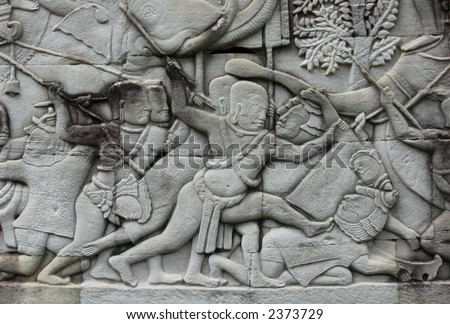
One bit of evidence he cited was ancient depictions of warriors: relief carvings, sculptures, ceramics etc This struck a deep cord in me since I'd studied sculpture in college and found myself to be a horrid contemporary artist but very interested in the very thing that Mr Plinck was discussing: the ancients had less knowledge but they accomplished much with that knowledge, things we're still trying to discern understand even with our contemporary science and etc (no, I'm not talking about crystals pyramids flying to Mars and that stuff)....To wit, here is a Cambodian carving that depicts stable squat posture, external rotation of the arms/shoulders/upper-carriage and just a beautiful solidity.
Here's another with a Khmer warrior showing how he stays on his back leg to maintain strong drive. Notice how his driving leg is internally rotated? while his lead leg is externally rotated? Spiraling out from the hips to create a strong, mobile frame to project power in the cleanest manner possible. Down power+stride.
Any of my regular guys will be very familiar with the baseball analogies I like to make. Notice how staying heavy on the back foot, for as long as you can manage, increases the power phase? (well, I do) Also, Ken is so smooth it kind of breaks my heart that he A. played for the Mariners B. was injured so often cause he was easily one of the greatest.
especially awesome is how Koga will just stay with Seoi nage, look at how :50 in he backsteps into his uke and then drives off that leg. Terrific stuff from a legend.
live load vs dead load
What is the gi (judo jacket+pants or kurtka for us Sambists) actually for? It's too heavy to be a day to day outfit, especially a proper one like the Mizunos I have or if you've ever randori'd vs a dude wearing a freaking Moskito then you really know what trashed fingertips is all about. The traditional kimono is generally a lighter material (at least insofar as its preserved these days)....
I think there is a hidden in plain sight aspect to the gi. The jacket grip allows a delay in the pulling that mimics the elastic action of a relaxed/working tension body transmitting power. Power being roughly defined here as from the hips down to the legs and back up to the hands. In essence, power is sourced from the ground.
The jacket can be used as grip-confirmation, generally for a more muscular throw, or as a way to connect to uke while maintaining connection within yourself. Properly utilized, the jacket grips can create space to counter-move then move or for outright hara2hara connection-hence control.
I hope that one (magical) day I could train with Katanishi Sensei. But in the meantime, his mastery and insight is amazing and I only have seen what videos are on internet and a few DVDs I have. This is an old video, he's gotten even better at explaining and defining Judo as a whole-body engagement and I don't hardly speak French! Notice the whip or elastic chain of movement or whatever the hell you want to call it, it's awesome:
Something about this delay action gives a sense of hara (center) to hara connection. I'm still mucking thru it, ruminating on exactly why...One thing that I've noticed is that one can attack uke and break his posture and then from that point on: it's as if he's a dead-load so that a clean/snatch sort of power chain will finish the throw versus having a connection in yourself which you tie into them and throw them as a live load: a more reactive, preemptive, hara to hara control. A dead load in engineering is just that: the non-changing, permanent materials that compose the structure. A live load is trickier: it's all those fatass tourists on that bridge over the koi pond and if they all simultaneously lean over to the right for a photo will the bridge hold? Will the bridge inter-accomodate? Can the body be trained for a shifting, dynamic, elastic load? If so what is the best approach?
this is the tip of the iceberg, the first tentacle breaking the surface to be followed by the rest of the mighty Cthulhu...
http://www.summeroflovecraft.com/images/Cthulhu-4.jpg
Sunday, August 5, 2012
Carl Paoli with a really good description of maintaining torque/posture/connection during squats:
Carl was on the Spanish National Gymnastics team, so he knows WTF he's talking about. As I've put more&more time into teaching Sambo beginners, the importance of basic movement and position strategy way surpasses any of the fancy martial arts looking stuff. Watch this video with this in mind: if you cannot organize your hips+legs, you will never properly transfer power from yourself into your opponent.
Especially if you're using such free and open power as good old Tokio Hirano:
Saturday, June 9, 2012
A cool video from the Paris Sambo competition. I want to emphasize a few points here so watch the vid and note the time stamps here:
@:42 ownage! Don't follow the dancing master...
@1:50 oh F-me! This is my opponent!?! ;-)
@2:25 there's the outside knee instead of the inside knee. I really want you guys to be more conditioned/developed before we try using this sort of lunging attack. What follows from the guy in red is some very half-hearted, shallow attacks. Execute! Don't waste so much energy!
@2:40 there's the bad ankle pick, see how the opponent just sits right up? Not good!
@3:50 try it once and almost get it? Try it again!!
@4:10 don't ever do crap like this, I'll kill you if you do!
@5:20 the "old guy uchimata" is very very effective, and trainable. Great throw to start from, balance, grips, posture etc and it actually works. Excellent throw.
@6:00 good sportsmanship. I always like that.
@6:50 why I don't like drop knee/Ippon Seoi nage
@8:00 watch how blue is setting up one or two throw options. Kind of see him thinking it thru....
Wednesday, May 9, 2012
smooth is fast, soft is strong
Kuroda sensei here executes ukimi which has a few translations but herein its a forward tumble where you really get under yourself.
Inoue executing a Seoi-nage with a deep squat posture.
This is more common among Asians and though I've heard it said its because of generalized proportions of leg-length etc My feeling/suspicion is that Asians generally don't sit as much as Westerners do. Like, on chairs and such as opposed to kneeling in seiza or the third world squat where you'll see old men/women waiting at the bus stop able to squat deeply, resting their butt on heels. Old, even young Westerners cannot even manage to do this and I blame chairs! No, sitting on stability balls does not count...
Anyhow, think of it like this: Kuroda's ukimi converts into Inoue's posture -as Tori-(the guy executing the throw) and the uke (guy that Inoue is throwing) is executing ukemi The tighter arc powers the looser arc.
As you get more relaxed it will become easier to execute this throw. It does not require strength, only good range of motion, stability in maintaining posture and a sort of relaxed-elastic power; which is simple in idea but will take time to develop. The details matter. Also, good breakfall/Ukemi skills matter which is why we're spending so much time with them. Not just for the sake of falling correctly and safely but because its the best way to develop the specific, smooth/soft power we'll need.
Consider expanding from that deep squat a bit, remaining relaxed enough -just enough- that you don't lose posture and can support the momentary addition of uke's weight. Using the correct angles and directions of push/pull etc etc you can be more upright and execute very smooth, elegant throws such as the man-himself here: Katanishi-san
Thursday, May 3, 2012
I've been holding back on you guys. I needed to formulate some things before I was ready to restart this blog...
little circle drives big circle
ukimi=little circle: http://youtu.be/JwHX6kR_Se0
ukemi=big circle: http://youtu.be/iKE7WS8N3Kw
Inoue puts it all together: http://youtu.be/JXFUrzBtsrY
Think of it as tori is the little circle and uke is the big circle.
Super-geek-time. Timmy goes thru his mechanics and note that his first movement is basically backward, though he's falling forward. That is the contradictory power we touch on. He falls into the direction opposite to his loading, in particular re: his hips. From there its a matter of the small circle@center (hips) projecting out to the big circle (hands) to generate the power.
http://youtu.be/wnPFSDTU_ng
A pitcher in MLB has an advantage in stepping off his mound. You can't really increase power as you're only "so strong" and you can't increase speed as your limbs+body will only go so fast but what you really can change is the mass which stepping down off the mound changes dramatically. The relationship between height of drop and mass is something like 2-3 times greater. What is the point?!? It's all down power!
Look again at Inoue, what he does is go from a position of stability and drops ~in a relaxed transition~ into another position of stability. Those of you who were at the last class saw how I launched Judd with this tight circle, tightly crouched squat. It had very little strength involved in the release and in the third try where I could barely control my own over-rotation I was completely committed to the mechanics.
Notice I said "mechanics" not "throw" that is where we need to work from. The throw is a causal relationship. The mechanics are deterministic, how you move is everything. It's the only thing. So, therefore, back to breakfalls! Ukemi! Ukikmi!
Monday, November 1, 2010
back in the saddle...
I've had a few breakthroughs in the past year but haven't had the time to codify them into anything useful, explanations to come...
Self-defense class geared specifically for Crossfit people; if it works it will be pretty huge.
Clinic #1:
Gulag-fit as a warmup
startle/flinch reactions, the Soviet Ministry of Sport and you.
it's 90% psychological, it doesn't take much skill for some asshole to hide behind a dumpster and hit you on the head with a pipe...
fighting is: a continuum, a spectrum, an outcome of violence. You did not choose this but you will not allow this to happen to you.
Most people fight out of cowardice i.e something to prove or vanity. The rest are basically cannibals and need to be dealt with as such.
Pepper Spray and et al is a half-measure, carry a knife and show them that you are a predator, not prey.
martial art=minimum effort for maximum effect, a lifetime study
self-defense=maximum effort for maximum effect, immediate outcome. Assume the worst otherwise WTF are you fighting for?
Professional:
neo-cortex trained under 1,000's of hrs of grueling, demanding duress. Fine motor skills can supplant the survival mechanism. Context-specific.
Civilian:
limbic system dependant, instinct and large muscle motions, difficult to overcome without specific training, CNS will sacrifice the body to survive...atextual
key#2 series
Soviet Subway drill
"We are a biped predator and that sucks" from close/cover-up into open/jab-out reactions
body-contact along the off-angle, understand how to break to the rear-corner.
You are not fighting their hand/foot/knife/etc you are fighting their CNS; their centerline. Methods of attacking the centerline. The whole body fights as a unit.
Self-defense class geared specifically for Crossfit people; if it works it will be pretty huge.
Clinic #1:
Gulag-fit as a warmup
startle/flinch reactions, the Soviet Ministry of Sport and you.
it's 90% psychological, it doesn't take much skill for some asshole to hide behind a dumpster and hit you on the head with a pipe...
fighting is: a continuum, a spectrum, an outcome of violence. You did not choose this but you will not allow this to happen to you.
Most people fight out of cowardice i.e something to prove or vanity. The rest are basically cannibals and need to be dealt with as such.
Pepper Spray and et al is a half-measure, carry a knife and show them that you are a predator, not prey.
martial art=minimum effort for maximum effect, a lifetime study
self-defense=maximum effort for maximum effect, immediate outcome. Assume the worst otherwise WTF are you fighting for?
Professional:
neo-cortex trained under 1,000's of hrs of grueling, demanding duress. Fine motor skills can supplant the survival mechanism. Context-specific.
Civilian:
limbic system dependant, instinct and large muscle motions, difficult to overcome without specific training, CNS will sacrifice the body to survive...atextual
key#2 series
Soviet Subway drill
"We are a biped predator and that sucks" from close/cover-up into open/jab-out reactions
body-contact along the off-angle, understand how to break to the rear-corner.
You are not fighting their hand/foot/knife/etc you are fighting their CNS; their centerline. Methods of attacking the centerline. The whole body fights as a unit.
Subscribe to:
Posts (Atom)